As offices nationwide closed in March 2020, the U.S. Department of Homeland Security (DHS) temporarily exempted fully remote employees from the employment eligibility verification physical inspection requirements for Form I-9 processing. At that time, DHS confirmed that employees working remotely due to COVID-19 would remain exempt from the requirements until the earlier of: 1) when the employee begins non-remote employment on a regular, consistent, or predictable basis; or 2) when DHS terminates I-9 flexibilities.
This DHS flexibility applies only to workers who were hired on or after March 20, 2020 and who are working exclusively in a remote setting due to COVID-19-related precautions. For new hires subject to these rules, employers are not required to review the employee’s identity and employment authorization documents in the employee’s presence and instead can inspect the document remotely and retain copies. Employers are required to maintain written documentation of this remote onboarding and verification, including annotating Section 2 of Form I-9 to indicate that documents were inspected remotely. Employers are later required to physically examine the documents in person and update Form I-9 accordingly once DHS terminates flexibilities or the presidential COVID-19 National Emergency declaration is terminated, whichever is earlier. If a worker begins regular, consistent, non-remote employment before either event occurs, the employer must complete the physical inspection at that time.
Since introducing this guidance in March 2020, DHS has provided near-monthly updates extending the flexibility for 30 days at a time. As of May 26, 2021, Immigration and Customs Enforcement (ICE) and DHS extended I-9 flexibility through August 31, 2021. Importantly, this guidance applies only to employers and workplaces operating remotely. Under DHS’ guidance, “If there are employees physically present at a work location, no exceptions are being implemented at this time for in-person verification of identity and employment eligibility documentation for Form I-9, Employment Eligibility Verification.”
Once normal in-person operations resume for a business, all employees who onboarded with remote verification must complete in person verification within three business days. If your workforce has returned to the workplace already, you should take immediate action to ensure that all required physical inspection of documents is completed as soon as feasible.
I-9 document inspection can be carried out by the employer, or any authorized representative designated by the employer. If you have any questions about I-9 compliance, please reach out to your Parker Gallini attorney.
National Interest Exceptions Now Valid for 12 Months and Multiple US Entries
With COVID-19 travel restrictions still in place for a number of countries worldwide, many foreign nationals traveling to the U.S. from or through restricted countries require an exception from the restrictions authorized by the U.S. Department of State (DOS). Throughout the pandemic, DOS has accepted requests for National Interest Exceptions (NIEs) from the travel restrictions based on evolving criteria benefitting U.S. interests, such as support of critical U.S. infrastructure or direction of significant economic activity. Each consular post is responsible for processing NIEs within the post’s jurisdiction, and NIEs were valid for one U.S. entry within 30 days of approval. On July 6, 2021, DOS announced that all NIE waivers issued in the last 12 months are automatically extended for 12 months from the date of approval and are valid for multiple entries, as long as they are used for the same purpose for which they were granted. This 12-month period of validity will also apply to all newly issued NIE waivers. This is a significant benefit to anyone who has already been issued an NIE waiver. In addition, it should reduce the number of NIE waiver requests at consular posts thus hopefully reducing wait times for new waivers.
DHS has Relaunched the International Entrepreneur Rule
Earlier this year, the U.S. Department of Homeland Security (DHS) relaunched the International Entrepreneur Rule (IER), allowing DHS to exercise discretionary authority to grant temporary entry for up to 30 months to foreign national entrepreneurs who provide “significant public benefit” to the U.S. through their work with a recently-formed start-up. Significant public benefit can be demonstrated through significant capital investment (over $250,000) from established U.S. investors; receipt of at least $100,000 of federal, state, or local government funding; or a combination of partial funding and compelling evidence of the potential for growth, such as the entrepreneur having a strong record of start-up success, acceptance into a reputable accelerator, or proof that the start-up has produced cutting-edge research and/or created new technologies. To qualify, an entrepreneur must own at least 10% in a start-up created in the last five years that has already done some business and must maintain at least a 5% interest over time. Additionally, an entrepreneur must play an active and role in the start-up’s operations.
IER parole is available to an entrepreneur and their dependent family members for a total of 60 months – 30 months initial admission, with one opportunity to be “re-paroled” – provided that the entrepreneur can demonstrate that the start-up has received at least $500,000 of additional funding; has generated $500,000 revenue at a 20% annual growth rate; has created at least 5 qualifying jobs; or can demonstrate comparable compelling evidence of the start-up’s continued potential for rapid growth and job creation. Only 3 entrepreneurs per start-up may receive IER parole.
IER parole is discretionary, so it can be denied or revoked by DHS based on derogatory evidence such as criminal conduct, fraud, or national security concerns. A parolee must maintain a household income of at least 400% above the current poverty level while in the U.S., which is currently about $70,000 for a two-person household. IER parole alone does not provide a green card pathway, and an entrepreneur must successfully apply for admission in another classification to remain in the U.S. after the IER parole expires.
The Biden Administration has committed to reviewing current immigration regulations and policies to identify ways to improve the United States’ immigration system. Recent policy changes include broader criteria for expedited processing, more generous RFE practices, and extended work and travel authorization for green card applicants.
On June 9, 2021, USCIS made three significant announcements for policy changes that improve immigration services for benefit requestors.
1. USCIS Clarified and Expanded Access to Expedited Processing
USCIS considers requests for expedited processing on a case-by-case basis and has sole discretion to grant expedited processing. In recent years, USCIS has rarely granted these requests. Last week’s update to the USCIS Policy Manual provides detailed explanations of the criteria USCIS considers when expediting a benefit request, including explaining USCIS’ process for considering these requests.
The most common basis for expedite requests is severe financial loss for a company or a person. USCIS’ new guidance explains circumstances that can demonstrate severe financial loss to warrant expedited processing such as:
A business is at risk of failing
A business will lose a critical contract
A business will be required to lay off other employees
A person’s job loss will cause severe financial hardship in their individual circumstances
A person will lose critical benefits
USCIS confirmed that they do not generally honor expedited requests where premium processing is available, and they also will not grant expedited processing where the need for urgent action results from applicant or petitioner failure to timely file or respond to USCIS requests.
The new guidance also allows qualifying nonprofit and cultural organizations to request expedited processing where there is benefit to interests of the United States.
2. Requests for Evidence and Notices of Intent to Deny
USCIS is returning to longstanding adjudicatory practices in place from June 2013 to July 2018, which direct USCIS officers to issue Requests for Evidence (RFEs) and Notices of Intent to Deny (NOID) where additional evidence could demonstrate eligibility for a requested immigration benefit.
This action included rescinding a July 2018 policy memorandum that expanded USCIS officers’ discretion to deny applications and petitions without first issuing an RFE or NOID in cases that are filed without required initial evidence. With this return to prior position, USCIS will now give benefit requestors an opportunity to correct mistakes and unintentional omissions through RFE and NOID responses.
3. Employment Authorization Documents
USCIS will begin issuing 2-year initial and renewal EADs for certain adjustment of status applicants. Increasing the validity period of these EADs from 1 year to 2 years will reduce the number of EAD applications USCIS receives, freeing up agency resources and hopefully reducing the time it now takes the USCIS to process EAD applications.
Contact your Parker Gallini attorney with any questions about the status of USCIS policy changes and any impact to your case.
The U.S. State Department has expanded eligibility for National Interest Exceptions to regional and country-specific COVID-19 Travel Bans
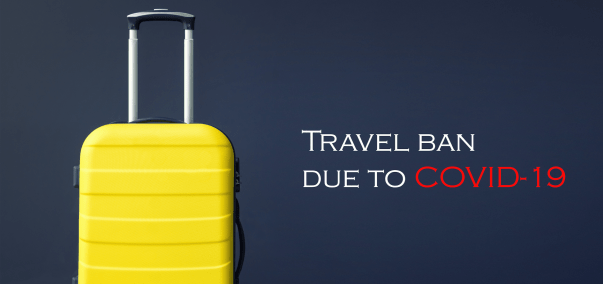
On May 27th, the U.S. State Department announced an expansion in eligibility for National Interest Exception waivers to the various regional and country-specific COVID-19 Travel Bans. Over the past year in response to the COVID-19 pandemic, the U.S. has imposed a ban on anyone traveling to the U.S. from the China, Brazil, India, Iran, the so-called Schengen countries (the countries of western Europe) and South Africa. These Travel Bans all contain a number of exceptions including for foreign nationals whose travel is in the national interest of the United States. The categories of who may apply for a National Interest Exception (“NIE”) waiver to these Travel Bans has changed over time. Since April of 2021, the State Department has allowed applications for NIEs for foreign nationals whose travel involves the provision of “vital support for a critical infrastructure” sector in the United States. However, the State Department appears to have taken a very restrictive stance on these applications. Under the April 2021 criteria, fewer NIEs were approved than were under earlier criteria based solely on economic benefit to the U.S.
The latest announcement on May 27th makes important changes to eligibility for an NIE waiver, again allowing for NIEs based on economic impact. While the category of providing “vital support for critical infrastructure” remains, a sub-category has been added for foreign nationals providing “executive direction for critical infrastructure.” In addition, the State Department has added a category for foreign nationals that provide “vital support or executive direction for significant economic activity in the United States.” This new standard will make it easier for executive-level employees to obtain an NIE waiver across industries. In addition, the reference to “significant economic activity” broadens the scope of eligibility for the waiver more generally.
We will up-date the Parker Gallini LLP web site with any changes or developments with respect to NIE waivers.
USCIS has announced that they will suspend biometrics requirements for all H-4 and L-2 nonimmigrants beginning on May 17, 2021. The suspension of biometrics is intended to help USCIS to aggressively address the backlog of Form I-539 and Form-I765 filings for H-4 and L-2 spouses.
USCIS estimates that the current number of Form I-539s for H-4 and L-2 spouses in the backlog is approximately 123,000 and estimates that the number of Form I-765s for H-4 and L-2 spouses in the backlog is approximately 57,500. The new policy suspending biometrics will apply to any pending cases that have not already been scheduled for biometrics appointments and to new cases filed after the effective date. In addition to suspending biometrics, USCIS has also confirmed that they are focusing resources on adjudicating these applications, including dedicating approximately 120 officers to these applications and scheduling training for another 33 dedicated officers in May 2021.
The Department of Homeland Security has also withdrawn a proposed rule that would have expanded biometrics collection by removing age restrictions and requiring submission of biometrics for every applicant, petitioner, sponsor, beneficiary, or other individual filing for or associated with any immigration or naturalization benefit or request unless DHS waived or exempted the biometrics requirement. The withdrawal follows the Executive Order 14012, Restoring Faith in Our Legal Immigration Systems and Strengthening Integration and Inclusion Efforts for New Americans, and additional administration priorities to reduce barriers and undue burdens in the immigration system.
DHS will continue to require submission of biometrics in cases where the collected information supports national security, identity management, fraud prevention and program integrity.
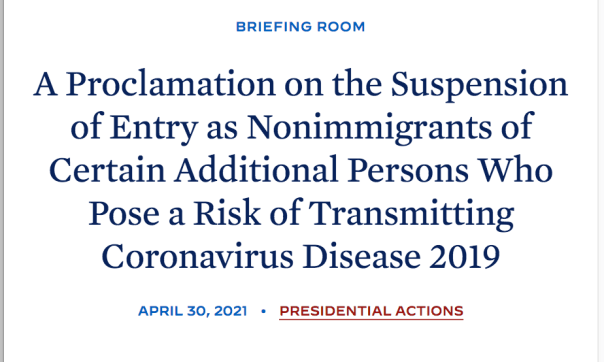
In addition, the Proclamation exempts certain travelers including Crewman, Foreign Diplomats and members of the U.S. military, as well as:
Any nonimmigrant who is the spouse of a U.S. citizen or lawful permanent resident;
Any nonimmigrant who is the parent of a U.S. citizen or lawful permanent resident, provided that the U.S. citizen or lawful permanent resident child is unmarried and under the age of 21;
Any nonimmigrant who is the sibling of a U.S. citizen or lawful permanent resident, provided that both are unmarried and under the age of 21;
Any nonimmigrant who is the child, foster child, or ward of a U.S. citizen or lawful permanent resident, or who is a prospective adoptee;
Any nonimmigrant whose entry would be in the national interest, as determined by the Secretary of State, the Secretary of Homeland Security, or their designees.
This Proclamation came into effect starting at 12:01am on Tuesday May 4th and will continue until it is terminated by the President.
The following are several points to note about the impact of the “India Travel Ban” Proclamation:
The Ban applies to foreign nationals seeking to enter the US as nonimmigrants – that is foreign nationals on temporary working visas like the H-1B, the L-1 and the B-1/B-2 Business Visitor Visa, who have been in India within the prior 14 days. It applies to the citizen of any country in the world if they travelled to India within the 14 day period.
Several of the exemptions from the Travel Ban listed above have potentially broad application. As an example, the 2nd exemption listed above would apply to an Indian national with a valid H-1B visa and her husband with an H-4 visa who have a child born in the US (who is thus a U.S. citizen) who is under the age of 21. Similarly, the 3rd exemption would apply to the minor and unmarried brother or sister of that U.S. citizen child.
The Secretary of State has identified several categories of people that will fall under the “national interest” exception to the Travel Ban (the 5th exemption listed above), which includes the following:
Travelers who are coming to the U.S. to provide “vital support for critical infrastructure sectors” (this includes 16 different infrastructure sectors including Healthcare, Information Technology, Communications, Energy and Finance);
F-1 and M-1 Students and certain academics covered by J-1 exchange visitor programs; and
Journalists.
People seeking to avoid the Travel Ban based on an argument of “national interest” must apply for a “national interest exception” waiver at their local U.S. Consulate. The rules for how to make these applications and what to include vary from Consulate to Consulate as does the time frame for getting a response, which can be as long as 60 days. Given the severity of the COVID-19 situation in India, we expect that U.S. Consulates there will be leanly staffed and that “national interest exception” waivers will take longer than usual.
In addition, our office has assisted a number of clients applying for a “national interest exception” waiver based on providing “vital support for a critical infrastructure sector” in other countries that are currently subject the same Travel Ban and have found that the standard for approval of an exemption in this category is very high – and that accordingly, the approval rate is low.
One approach that can be used to avoid the application of the Travel Ban is to travel to a third country that is not subject to a travel ban and spend 14 full days there. After this time has run (and more than 14 days has elapsed since the foreign national was in India), the traveler can then fly from the third country to the United States. Currently, the U.S. has imposed a travel ban on the Schengen countries of Western Europe, the United Kingdom and Ireland, Brazil, China, South Africa, Iran and now India.
In case you missed it: On May 4, Parker Gallini hosted a webinar to discuss the immigration landscape following the FY 2022 H-1B lottery. Our webinar covered immigration alternatives for foreign national employees not selected in the lottery, including the use of student status to gain CPT work authorization, as well as updates on the latest changes in immigration policy. You can watch the video recording of the webinar below, and download the slideshow presentations on our Resources page.
USCIS announced on March 30th that they had received enough electronic registrations during the initial registration period to reach the fiscal year 2022 H-1B cap and had notified all prospective petitioners with selected registrations. Each year there are 65,000 regular H-1B visas available and an additional 20,000 H-1B visas reserved for individuals with U.S. Master’s degrees. USCIS has not yet released information about how many registrations were submitted.
According to USCIS, all registrations submitted will now show one of the following statuses in employer and legal representative accounts:
Selected – the registration was selected, and the sponsoring employer may submit an H-1B petition on the individual’s behalf before June 30
Submitted – the registration was not selected but will remain open until the annual H-1B cap is met through approved H-1B petitions.
Denied – USCIS determined that duplicate registrations were submitted for an individual and denied all registrations for that individual.
Invalidated – Failed Payment – The payment for the registration was declined or invalid. The registration was not included in the lottery selection.
With the lottery completed, as of April 1st USCIS has begun accepting fiscal year 2022 cap-subject H-1B petitions for registrations that were selected. They will continue accepting petitions for at least 90 days, until June 30th. Although USCIS released a new Form I-129 on March 10, 2021, they will accept prior edition dates as well as the new form, until July 1, 2021. USCIS has not announced any suspension of Premium Processing service for FY 2022 cap-subject H-1B petitions.
If you have not already, contact your Parker Gallini attorney for next steps on selected registrations. Initial reports suggest high numbers of registrations for fiscal year 2022 and lower selection rates than in last year’s lottery. If you have employees who were not selected, be sure to sign up for Parker Gallini’s webinar on May 4th, which will include more information on alternatives to cap-subject H-1Bs for employees who were not selected in the lottery.
2. Public Charge Rule Vacated
The much-anticipated end to the 2019 “Inadmissibility on Public Charge Grounds” rule (Public Charge Final Rule) promulgated by the Trump Administration came on March 9th when the U.S. Court of Appeals for the 7th Circuit lifted its stay of the U.S. District Court for the Northern District of Illinois’ order vacating the rule. This move, which reimplemented a nationwide injunction of the Public Charge Final Rule, came after the Biden Administration’s Department of Justice announced that they would no longer be defending the controversial rule in court.
On March 11th, the Department of Homeland Security (DHS) filed a rule with the Federal Register to formally remove the Public Charge Rule from the Code of Federal Regulations. DHS also submitted a notice that same day withdrawing the October 2, 2020 proposed rule related to the Form I-864 Affidavit of Support, which would have changed evidentiary requirements for immigrant sponsorship and made that process more burdensome for sponsors. DHS also announced that the public charge admissibility policy in place prior to the 2019 public charge rule is back in effect. This policy limits the basis for public charge findings significantly, allowing for the receipt of several important non-cash benefits including certain housing, food, and health care benefits.
Regarding the changes, Secretary of Homeland Security Alejandro N. Mayorkas stated, “DHS closed the book on the public charge rule…DHS is committed to implementing reforms that improve our immigration system and reduce unnecessary barriers to legal immigration.”
As a result of these changes, USCIS is no longer considering Public Charge information submitted to meet the requirements of the vacated Public Charge, including financial information submitted with Form I-944, Declaration of Self-Sufficiency. New petitions and applications should be submitted without providing that information. Applicants and petitioners who received a Request for Evidence (RFE) or Notice of Intent to Deny (NOID) requesting information related solely to the Public Charge Final rule do not need to respond to those requests, although they do need to respond to other aspects of any RFE or NOID.
Effective March 9th, applicants filing Form I-485 for adjustment of status no longer need to submit Form I-944, Declaration of Self-Sufficiency. In addition, USCIS published new form editions for relevant forms to remove questions related to the public charge rule. These new forms have a March 10, 2021 edition date and include the following:
I-864, I-864A, I-864EZ, I-864W
I-539, I-539A
I-129CW, I-129CWR
I-129
I-485, I-485A, I-485J
I-912
Starting April 19, 2021, USCIS will only accept the new edition date for the above forms, with the exception of Form I-129. USCIS will accept previous editions of Form I-129 until July 1, 2021.
The Department of State announced on April 1, 2021 that Presidential Proclamation 10052 (“the Proclamation”) expired on March 31, 2021. This Proclamation halted issuance visas for certain H-1B, H-2B, J, and L nonimmigrants. Effective April 1st, the Department of State has resumed processing visas for individuals affected by the Proclamation. Applicants who were denied visas because of the Proclamation may reapply but will need to submit a new application and pay a new application fee.
U.S. Consulates and Embassies worldwide are reopening on a post-by-post basis and will continue to have limited visa appointment availability for some time. Consular posts are prioritizing U.S. citizen services first and are working towards a full resumption of routine visa services. Expect delays in scheduling appointments.
The April Visa Bulletin was published in mid-March, in line with recent trends towards earlier publication of the monthly Visa Bulletin under the Biden Administration. For April, the employment-based first preference category is current across all countries of chargeability, including India and China. See full bulletin here.
The U.S. Department of State (DOS) announced the return of Charlie Oppenheim, Chief of the Visa Control and Reporting Division, to the public eye. The DOS will be hosting monthly “Chats with Charlie” as livestreams on the DOS YouTube channel. These chats will address pre-submitted and real-time questions regarding the visa bulletin and predicted trends. Recordings of the livestream and can be watched at a later date on the DOS YouTube channel, including the April Visa Bulletin review, which is currently available. Key predictions from the April Visa Bulletin include the following:
The EB-1 category should remain current for all countries for the remainder of the fiscal year, which runs through September 30, 2021.
The COVID-19 pandemic continues to impact visa issuance, particularly in the family-based categories. As a result, approximately 135,000 unused family-based visas will likely be added to employment-based visa preference categories, for a total of approximately 275,000 employment-based visas available in fiscal year 2022.
EB-2 and EB-3 priority dates for India and China should advance rapidly beginning in May 2021 and potentially continuing into fiscal year 2022.
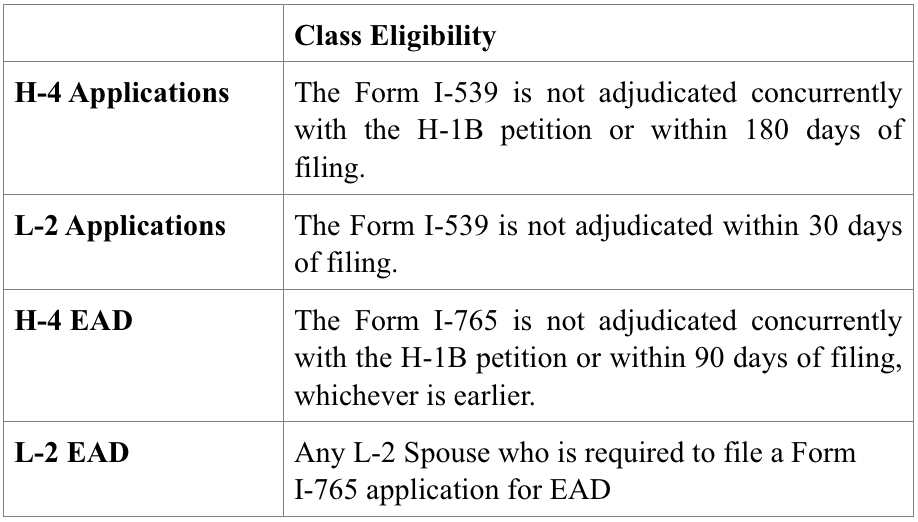
Frustrated by lengthy delays that can run for 18 months or more, on March 22, 2021 the American Immigration Lawyers Association (“AILA”) filed a class action lawsuit against the U.S. Citizenship and Immigration Services (“USCIS”) to force the government agency to speed up processing of applications for the dependents of H-1B and L-1 workers. Until former President Trump’s “Buy American” Executive Order, these applications had traditionally been adjudicated at the same time as the principal worker’s underlying H-1B or L-1 petition.However, because of its interpretation of Trump’s Executive Order, USCIS added additional measures to the processing of these cases that have caused delays not previously seen before.
The impact of the delays can be quite severe to affected spouses.For example, most states tie a foreign national’s driver’s license validity to a foreign national’s approved period of admission. Since applications cannot be filed more than the 6 months in advance of the expiration of a foreign national’s status and dependent applications are not eligible for premium processing service, if processing times exceed 6 months (which is frequently the case) then it is impossible to avoid a lapse in the foreign national’s ability to drive.
Furthermore, since the Employment Authorization Documents (“EADs”) that are issued to H-4 and L-2 spouses are not eligible for the automatic 180-day extension of their employment authorization that is provided to other categories when a renewal application is timely filed, a delay in processing of over 6 months also guarantees that these spouses, who are often highly educated, have periods where they are unable to work.
The lawsuit details several ways in which the Trump administration added unnecessary additional steps to the adjudication of these applications that has resulted in processing times doubling or tripling.It sets the following classes:
The primary relief requested by AILA is that USCIS promptly adjudicate any related filing within 7 days of a foreign national becoming a class member.It also is requesting that L-2 spouses no longer be required to apply for an EAD and instead by employment authorized merely by virtue of being the spouse of an L-1 worker.
This is an important step in attempting to undo some of the real harm caused by former President Trump’s policies, and we will keep you informed on any important developments.
In the last days of the Trump administration, the US Department of Labor (DOL) published a final rule entitled “Strengthening Wage Protections for the Temporary and Permanent Employment of Certain Aliens in the United States,” scheduling the rule to take effect on March 15, 2021 with adjustments to prevailing wage levels beginning on July 1, 2021. The final rule built on an interim final rule initially published and enacted in October 2020, which federal courts struck down in December 2020 in response to lawsuits filed by numerous business and universities led by the US Chamber of Commerce. The final rule changed the computation of prevailing wage levels, effectively raising salaries by an average of 25% for all occupations and wage levels in the Occupational Employment Statistics (OES) wage survey administered by the Bureau of Labor Statistics and impacting prevailing wage requirements for nonimmigrant sponsorship in the H-1B, H-1B1, and E-3 categories and for PERM-based immigrant visa sponsorship.
On January 20, 2021, the published final rule became subject to the “Regulatory Freeze Pending Review” memorandum from President Biden’s Chief of Staff, delaying the implementation of the final rule for 60 days pending administrative review. Subsequently, on February 1, 2021, the DOL published a notice officially proposing to delay the effective date of the final rule until May 14, 2021, which was confirmed in a final rule published on March 12, 2021. On February 19, 2021, the businesses and universities who initially challenged the interim final rule updated their lawsuit to challenge the final rule; this litigation is ongoing. On March 22, 2021, the DOL proposed a further 18-month delay of the final rule, until November 14, 2022, with adjustments to prevailing wage levels beginning on January 1, 2023.The DOL is accepting public comments on the proposed delay through April 21, 2021. Assuming the proposed delay moves forward, the DOL may revise the rule further or withdraw it entirely before the new effective date in November 2022.
While the Trumpadministration justified the final rule by arguing that it would ensure that the employment of foreign national workers in the US “does not adversely affect the wages and job opportunities of US workers,” many experts agree that making the US employment of foreign workers more costly is far more likely to result in companies increasing overseas hiring instead of hiring US workers and slowing the migration of foreign talent and investment dollars to the US. Existing H-1B rules already require employers to pay temporary foreign workers the greater of the in-house wages the employer pays to other workers in the same position with similar experience and qualifications or the prevailing wage for the occupational classification in the area of employment, and the H-1B1 and E-3 categories share similar requirements. Most often, employers determine the appropriate prevailing wage for the H-1B, H-1B1, and E-3 categories from OES data. When sponsoring a foreign worker for permanent residence in the US in the EB-2 and EB-3 categories, an employer must obtain a prevailing wage determination from the DOL, which relies on OES wages absent an applicable wage survey, collective bargaining agreement or prevailing wage law. These existing rules allow US employers to hire skilled foreign workers where needed, while still offering robust protections for US workers’ jobs and wages.
Now, the DOL is engaged in a comprehensive review of the prevailing wage system, recently publishing a Request for Information (RFI) inviting interested parties to provide information on data sources and methodologies for determining prevailing wages in the H-1B, H-1B1, E-3, and PERM contexts. Specifically, the DOL is soliciting “written narratives…, quantitative or qualitative data analysis, reports or studies, and other estimation techniques and methodologies, whether published or unpublished, relevant to determining wage values or levels within a specific occupational wage distribution and geographic area,” which can be submitted through June 1, 2021. Likely, the DOL’s next step will be a new round of proposed rulemaking to revise the delayed final rule, which will also be open to public comment.
Contact your Parker Gallini attorney with any questions about the status of changes to the prevailing wage system.

 USCIS estimates that the current number of Form I-539s for H-4 and L-2 spouses in the backlog is approximately 123,000 and estimates that the number of Form I-765s for H-4 and L-2 spouses in the backlog is approximately 57,500. The new policy suspending biometrics will apply to any pending cases that have not already been scheduled for biometrics appointments and to new cases filed after the effective date. In addition to suspending biometrics, USCIS has also confirmed that they are focusing resources on adjudicating these applications, including dedicating approximately 120 officers to these applications and scheduling training for another 33 dedicated officers in May 2021.
 On April 30, 2021, President Biden issued a
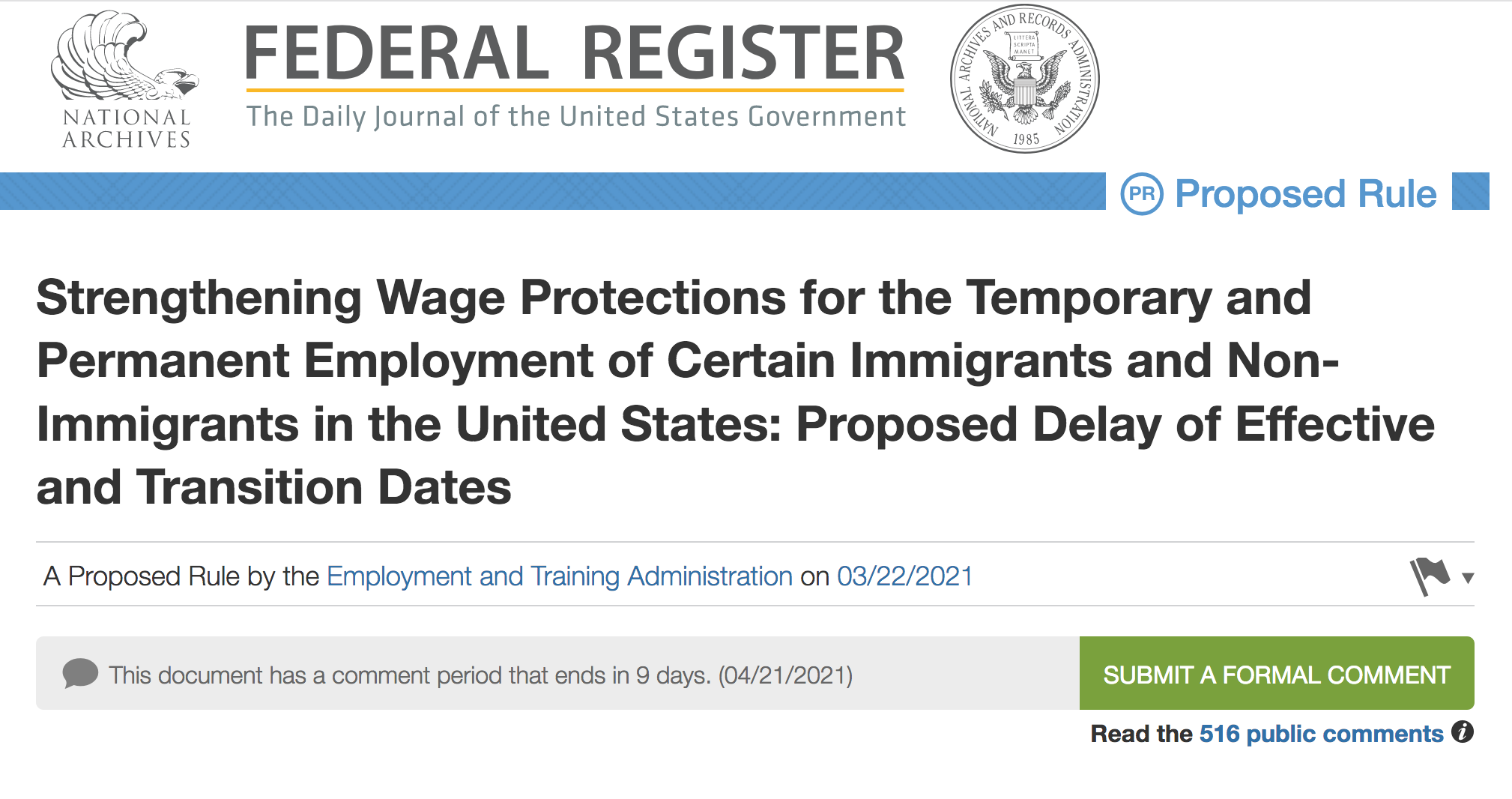 In the last days of the Trump administration, the US Department of Labor (DOL) published a
 Immigration at Work