Developing an Immigration Sponsorship Policy — Updated Considerations for Current Conditions

Immigration answersOne of the most popular articles on our website has just been updated by Immigration Attorneys John Gallini and Victoria Morte. In Managing Immigration Sponsorship: A Flexible Policy Is the Wisest Strategy, John and Vicki lay out key considerations in developing an effective and efficient immigration sponsorship policy, and stress the importance of flexibility.

Hiring and employing a foreign national, even temporarily, requires a commitment of your company’s administrative time and financial resources to successfully navigate the complex immigration system, including planning for near-term temporary work authorization and long-term strategy for green card sponsorship. Further, immigration sponsorship can be a powerful incentive and retention tool that may help to draw and retain talent.

Accordingly, efficient and cost-effective management of an immigration sponsorship requires a flexible company policy that accounts for shifts in the legal landscape, fluctuating processing times, economic volatility, and foreign national employee needs and hopes.

The article lays out the questions to ask when designing a policy such as:

  • Who will pay for immigration sponsorship fees and expenses?
  • When should Green Card sponsorship be offered?

Additionally, the article suggests key components to integrate into a flexible policy, with practical examples for implementation. Read the article here, and contact a Parker Gallini immigration attorney for assistance in developing your policy.

Tagged with: , ,
Posted in Immigration Law

How to Handle Layoffs Involving Nonimmigrant Visa Employees

Nonimmigrant visa layoffsEmployers and nonimmigrant visa employees working at a company facing layoffs must be aware of applicable rules and available visa options in the event that employment ends.

Immigration Attorney Shelley Starzyk provides a quick rundown of what to do in the face of a layoff of a nonimmigrant visa employee. Options may include case-specific strategies involving:

  • 60-day grace period
  • Portability to a new employer
  • Changing status
  • Departing USA

Read the article, Nonimmigrant Visa Employee Options Available in the Event of a Layoff, on the Parker Gallini website to learn more about the impact and obligations for employers and employees following layoffs. 

Tagged with: ,
Posted in Immigration Law

H-1B Visa Lottery: What You Should Know

Each year, USCIS runs a lottery to allocate 85,000 new H-1B visas to U.S. employers seeking to sponsor foreign national workers in “specialty occupation” positions across all industries.

Attorney Donald Parker has written a new article on our website that explains some basics and tips and what to expect in the coming H-1B visa lottery cap season. Learn more about how the lottery works, when you can submit petitions to USCIS, who is subject to the H-1B cap, and things to avoid in the process.

Now is the time to review your existing foreign national employees to see if any would be a good candidate for the H-1B visa and if your company and the employee would benefit from their having this status.

Read the article, The Annual H-1B Lottery Is Coming in March of 2023. Here’s What you Need to Know, and contact one of our immigration lawyers for assistance.


Tagged with: , ,
Posted in Immigration Law

Immigration Quick Takes — December 2022

Expect Delays

DOL Processing Times

The U.S. Department of Labor (DOL) has published updated processing times as of October 31, 2022, confirming that the Department continues to face internal staffing shortages and high demand. As a result, we have continued to see long delays in DOL processing times for prevailing wage requests and permanent labor certification (PERM) applications across the board.

Specifically, the DOL reported that as of October 31, it was on average processing Prevailing Wage Requests filed in January 2022, or 9 months. PERM applications are nearly as delayed, with the DOL reporting that as of October 31, 2022, they are processing PERM applications filed in February 2022, reflecting an average processing time of 8 months. PERM audit processing times reflect an additional 3-month delay, with the DOL currently performing audit reviews for PERM applications filed in December 2021. It remains to be seen whether these DOL processing times will continue to climb or whether potential economic slowdowns will reduce backlogs.

In light of these significant DOL processing delays, Parker Gallini urges employers to consider starting employment PERM-based green card cases for eligible employees at least six months or even a year sooner than previously contemplated to ensure adequate time for DOL processing. Reach out to your Parker Gallini attorney for more information about the PERM process or to start a case for your employee.

December 2022 Visa Bulletin Updates

Fiscal Year 2023 is now entering its third month, with the December 2022 Visa Bulletin reflecting retrogression in multiple employment based visa categories. USCIS has announced that they will continue to accept family and employment-based Adjustment of Status applications based on the Dates for Filing in December 2022.  

The December 2022 visa bulletin reflects retrogressions for the EB-2 and EB-3 India visa categories, and retrogressions for the EB-2 All Countries visa categories due to high visa demand. For December 2022, the EB-2 India category final action date has retrogressed to October 8, 2011. The Department of State attributes this EB-2 India visa retrogression to higher than anticipated demand in the first two months of FY2023. The Department of State also noted that the first two months of FY2023 have reflected higher than expected worldwide demand for EB-2 visas, leading to a retrogression in the All Countries category to a final action date of November 1, 2022 and an application filing date of December 1, 2022. In the December 2022 visa bulletin, the Department of State also noted that it anticipates that an increased demand with lower visa number availability for EB-1 for China and India may necessitate a retrogression in this visa category in the upcoming months.

Individuals who now have backlogged priority dates may have the opportunity to secure additional H-1B extensions as needed while awaiting visa bulletin advancement. Those with pending Adjustment of Status applications that are now backlogged can continue to renew EADs and Advance Parole documents as needed and may have opportunities to port employment. Consult with your Parker Gallini attorney if you have any questions about these options.

Ripple Effect of H-1B Layoffs

November 2022 saw a surge of over 50,000 tech worker layoffs in the United States, adding to a growing total across other industries as companies respond to inflation and economic uncertainty. While tech companies are typically among the highest users of the H-1B visa program, H-1B workers are sponsored in a wide variety of positions by companies in nearly every market sector.  

To transfer (or “port”) employment to a new employer and maintain status in the United States after a layoff, an H-1B worker has a grace period of up to 60 days to have a new employer’s H-1B petition filed on their behalf. If the H-1B worker’s existing I-94 expires prior to the 60-day mark, they will only have until the end of the I-94 validity to port their employment based on a new employer’s filed H-1B petition. Employers seeking to hire an H-1B worker who was recently laid off should also be mindful of the tight onboarding timeline required to keep H-1B status active.

When an H-1B employee is laid off, the sponsoring employer is required to offer to pay   the cost of reasonable return transportation to a laid-off H-1B worker’s home country. Sponsoring employers should also take steps to withdraw H-1B petitions and Labor Condition Applications for each laid-off H-1B worker. 

Layoffs may also have far-reaching consequences for companies and for sponsored workers who retain their jobs. In particular, in the context of PERM-based green card sponsorship, employers must comply with regulatory requirements to notify and consider all potentially qualified U.S. workers laid off within a six-month period preceding the filing of a PERM application. Potentially qualified U.S. workers includes laid-off U.S. workers who worked in the same geographic area of intended employment and in the same or a related occupation as the  PERM position being sponsored.  In practice, this leaves employers with the option of either delaying the filing of PERM applications for a minimum of six months following a layoff or contacting any laid-off U.S. workers who worked in the area of intended employment in the same or related occupation to invite them to apply for a sponsored PERM position.  Each option presents challenges in the PERM process, potentially resulting in significant delays or even the need to begin the PERM process over again.  In addition, multiple rounds of layoffs can force employers to put the PERM-based green card sponsorship process on hold company-wide for a period of time.  With current U.S. Dept. of Labor prevailing wage processing times averaging 8-10+ months, restarting or delaying a PERM process can pose serious risk to H-1B workers’ maintenance of status.

With ripple effects impacting ongoing nonimmigrant and immigrant sponsorship, layoffs are far from simple to navigate. Consult with your Parker Gallini attorney as soon as possible if your company is considering a workforce reduction.

Posted in Immigration Law

H-1B Visa Cap FAQ

Immigration answers

Our H-1B Visa Cap FAQ was recently updated by Attorney Donald W. Parker

U.S. employers use the H-1B program to employ tens of thousands of highly skilled workers. USCIS allocates the limited number of new H-1B visas through a lottery system on an annual basis. This FAQ provides information about the H-1B visa registration and lottery process.

Get the answers to these most frequently asked questions on our website’s H-1B Visa Cap FAQ.

  • What is an H-1B Visa?
  • Why are H-1B visas allocated by a lottery system?
  • How does the lottery process work?
  • My case was selected in the H-1B lottery, now what happens?
  • Is it true that the USCIS conducts multiple lotteries each year?
  • Is Premium Processing available for the H-1B Lottery?
  • Can my employer submit multiple H-1B lottery registrations for me?
  • Does the Lottery Process Apply to H-1B Transfers?
  • What are my options if my lottery registration is not selected?

Read the full article…

Posted in Uncategorized

Immigration Quick Takes — November 2022

Immigration News

Flexibility Extended for Deadlines for Responses to Requests for Evidence and Other Agency Requests 

USCIS has extended flexibility to respond to Agency requests received through January 24, 2023. Initially adopted in March of 2019 in response to the COVID-19 pandemic, this rule extends by 60 calendar days the due date for responses to various Agency requests. The rule applies to the following types of USCIS requests: Requests for Evidence; Continuations to Request Evidence (N-14); Notices of Intent to Deny; Notices of Intent to Revoke; Notices of Intent to Rescind; Notices of Intent to Terminate Regional Centers; Notices of Intent to Withdraw Temporary Protected Status; and Motions to Reopen an N-400 Pursuant to 8 CFR 335.5, Receipt of Derogatory Information After Grant. 

In addition, USCIS will consider a Form I-290B, Notice of Appeal or Motion, or Form N-336, Request for a Hearing on a Decision in Naturalization Proceedings (Under Section 336 of the INA) to be timely filed if received within 90 calendar days after the issuance of a decision or denial of a case dated between November 1, 2021, and January 24, 2023.

For more information about this extension of COVID-19 related flexibility in responding to Agency requests, contact your Parker Gallini attorney or see this USCIS Alert.

Recent Examples of Marriage-Based Applications for Permanent Residency Approved Without an Interview

Parker Gallini has recently seen U.S. Citizenship and Immigration Services (USCIS) approve a small number of marriage-based adjustment of status applications without an interview. This is notable because USCIS typically requires applicants for adjustment of status to permanent resident based on marriage to a U.S. citizen to appear in person at the local USCIS Field Office for a detailed interview along with their U.S. citizen spouse. At the interview, USCIS officers typically question both spouses at length about their marriage and relationship history. These interviews can be a source of stress and anxiety for applicants and their spouses, in part because of bad publicity about the nature of some officers’ questioning of applicants and because of the high stakes of the interview outcome. Although anecdotal evidence suggests that waivers of these interviews are the exception and not the rule, Parker Gallini applauds this move to streamline the green card process for spouses of U.S. citizens and reduce the stress of the process. We are monitoring for any updates regarding changes to official USCIS policy or written criteria that would be used to decide whether to waive the interview for a marriage-based green card case, as well as information about the numbers of cases approved without an interview. 

If you or someone you know is considering filing a marriage-based application for permanent residence, reach out to Parker Gallini for assistance with the process.

Latest Developments with the Petition Immigration Management Service (PIMS) System

PIMS (the Petition Information Management Service) is the U.S. Department of State’s electronic system that provides U.S. Consular posts with confirmation of nonimmigrant (H-1N, L-1, O-1, TN, etc.) visa petition approvals. Consular posts are required to verify the petition approval in PIMS before approving and issuing a petition-based nonimmigrant visa. The PIMS database is run by the U.S. State Department’s Kentucky Consular Center (KCC). One of the items included in PIMS is a scan of the approved nonimmigrant visa petition filing package.  Until recently, this scan was taken from a duplicate copy of the visa petition that Petitioners were required to submitted with the original nonimmigrant visa filing package to U.S. Citizenship & Immigration Services (“USCIS”).   

On October 3, 2022, USCIS indicated that it no longer requires the submission of a duplicate visa petition to accompany the original nonimmigrant visa petition filing. This is a welcome development as it will streamline the nonimmigrant visa petition filing package, cutting down on what is often a very thick filing package, as well as reducing shipping costs. Once USCIS approves a nonimmigrant visa petition, they now directly scan the petition into the PIMS system rather than sending a physical copy to the KCC to be scanned. USCIS notes that it is taking one to two weeks after approval of a case to get the scanned petition into the PIMS system.

In addition to this initial delay in uploading information to PIMS, for several months now, we have seen a marked increase in the number of nonimmigrant visa applications that are delayed because the PIMS system does not yet have evidence of the approval of the underlying visa petition. These delays can last for weeks and there is no way to confirm in advance whether a case has been properly loaded into the PIMS system.  While the U.S. State Department acknowledges the delay and states that it is working to resolve it, foreign nationals travelling abroad to apply for a nonimmigrant visa face the prospect of significant delays in being issued the visa. 

Finally, a reminder that because Consular posts are required to verify visa petition approvals through PIMS, a foreign national applying for a visa is not required to include the original copy of their Form I-797, visa petition approval notice as part of their visa application filing.  We recommend that a visa applicant include a photocopy copy, but not the original, of their Form I-797 approval notice.

We will provide up-dates on the situation with delays in loading information into the PIMS system as we have them.

Posted in Immigration Law

USCIS and I-9 Form COVID-19 Flexibilities Roundup

Flexibilities

The Department of Homeland Security (DHS) and US Citizenship and Immigration Service (USCIS) continue to extend flexibilities for immigration benefits and compliance due to the COVID-19 pandemic. Below is a list of COVID-19 flexibilities currently in place as of October 20, 2022.

Medical Exam Physician Signature Validity

USCIS normally requires that a civil surgeon’s signature on Form I-693, Report of Medical Examination and Vaccination Record be dated no more than 60 days before filing an application for immigration benefits, including Adjustment of Status. On December 9, 2021, USCIS suspended this requirement temporarily as an accommodation for COVID-19 related delays. USCIS recently announced that they are extending this temporary suspension of the 60-day requirement until March 31, 2023.  This suspension does not change the limited 2-year validity of the medical exam.

Responses to Request for Evidence and Other Response Deadline Flexibilities

USCIS has extended COVID-19-related flexibilities related to the filing of USCIS requested documentation through Oct. 23, 2022. Under these flexibilities, USCIS considers a response received within 60 calendar days after the due date listed in the following requests or notices to be timely filed, if the request or notice was issued between March 1, 2020, and Oct. 23, 2022. These flexibilities apply to the following types of USCIS requests: Requests for Evidence; Continuations to Request Evidence (N-14); Notices of Intent to Deny; Notices of Intent to Revoke; Notices of Intent to Rescind; Notices of Intent to Terminate regional centers; Notices of Intent to Withdraw Temporary Protected Status; and Motions to Reopen an N-400 Pursuant to 8 CFR 335.5, Receipt of Derogatory Information After Grant. USCIS should announce any further extensions on this response flexibility timeframe in the upcoming weeks.

I-9 Compliance Flexibilities

DHS has also extended certain COVID-19 flexibilities with respect to remote review of I-9 compliance documentation until July 31, 2023. 

 As of April 1, 2021, the requirement that employers inspect employees’ Form I-9 identity and employment eligibility documentation in-person applies only to those employees who physically report to work at a company location on any regular, consistent, or predictable basis.

If employees who were hired on or after April 1, 2021 work exclusively in a remote setting due to COVID-19 related precautions, they are temporarily exempt from the physical inspection requirements associated with the Employment Eligibility Verification (Form I-9) under INA 274A. However, once a remote employee undertakes non-remote employment on a regular, consistent, or predictable basis, or this extension of the flexibilities related to such requirements is terminated (whichever event occurs first), the employer will be expected to perform a physical inspection of the documents as required.

In the event an employer is unable to timely inspect and verify, in-person, the Form I-9 supporting documents of employee(s) hired since March 20, 2020, as described above, they may memorialize the reason(s) for this inability in a memorandum. Such a memorandum must be retained with each affected employee’s Form I-9, to be evaluated by DHS ICE on a case-by-case basis, in the event of a Form I-9 audit.

Despite these Form I-9 flexibilities, employers may choose to commence the in-person verification of identity and employment eligibility documentation for employees who were hired on or after March 20, 2020.

While these remote document inspection flexibilities remain in place for now, DHS has ended a separate temporary policy that allowed for Form I-9 verification based on expired List B documents. As of July 31, 2022, employers must ensure that Forms I-9 are updated for any current employee who presented an expired List B document between May 1, 2020 and April 30, 2022. 

USCIS COVID Policy on Reproduced Signature Flexibilities is now a Permanent USCIS Policy

As of July 25, 2022, USCIS has incorporated its temporary COVID 19 signature flexibility policy as a permanent USCIS policy. This signature flexibility policy allows USCIS to accept scanned, faxed, photocopied or similarly reproduced signed documents, provided that the copy is of an original document containing an original handwritten signature.

Tagged with: , , ,
Posted in Immigration Law

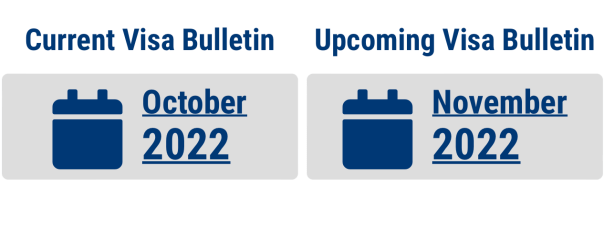
November 2022 Visa Bulletin & Immigrant Visa Availability

Visa Bulletin

Fiscal Year 2023 began on October 1, 2022 with approximately 60,000 unused family-based visas from FY 2022 rolling over into the FY 2023 employment-based allocation. With these additional visas, in total, there are approximately 200,000 immigrant visas available to employment-based immigrants and their dependents in FY 2023. 

Following rapid advancement in employment-based visa availability in FY 2021 and FY 2022 resulting in large part from the rollover of unused family-based visas, the visa bulletin has now idled for the first two months of FY 2023. The November 2022 Visa Bulletin is identical to the October 2022 Visa Bulletin for EB-1, EB-2, and EB-3 across all countries, and USCIS has announced that they will continue to accept Adjustment of Status applications based on the Dates for Filing in November 2022.  

With Final Action Dates holding steady across preference categories, individuals who now have backlogged priority dates may have the opportunity to secure additional H-1B extensions as needed while awaiting visa bulletin advancement. Those with pending Adjustment of Status applications that are now backlogged can continue to renew EADs and Advance Parole documents as needed and may have opportunities to port employment. Consult with your Parker Gallini attorney if you have any questions about these options.

Tagged with: , ,
Posted in Immigration Law

The 2023 H-1B Cap Lottery Process Kicks-Off on March 1, 2022

H-1B Visa USAEach year, 85,000 new H-1B visas become available to U.S. employers seeking to sponsor foreign national workers in “specialty occupation” positions across all industries. These 85,000 new H-1B visas are available in three distinct tranches:



  • 58,200 visas are available under the Regular Cap for foreign nationals who qualify for the H-1B classification by having a minimum of a U.S. or foreign Bachelor’s degree or a combination of education and experience that is equivalent to a U.S. Bachelor’s degree.
  • 20,000 H-1B visas are available under the advanced degree exemption, commonly known as the Master’s Cap, for foreign nationals who have earned a Master’s (or higher) degree in the U.S.
  • 6,800 visas are allocated to the H-1B1 visa category which is available to citizens of Singapore (5,400) and Chile (1,400).

Each year the demand for new H-1B visas in the first two tranches exceeds the number available. As a result, the U.S. Citizenship & Immigration Service (USCIS) allocates the new H-1B visas in these two tranches using a computer-based lottery system, selecting H-1B Cap Registrations submitted through USCIS’ online portal, myUSCIS. The last tranche of 6,800 H-1B1 visas has historically been under-utilized and remains available throughout the fiscal year. Unused visas from this tranche become available for H-1B use in the next fiscal year.

The lottery process for the Master’s Cap and Regular Cap visas is run in two steps. The first lottery selects enough H-1B registrations to satisfy the Regular Cap from a pool that includes both Regular and Master’s Cap H-1B registrations. The second lottery selects enough H-1B registrations to satisfy the Master’s Cap from H-1B registrations eligible for the Master’s Cap that were not selected in the first lottery. Because foreign nationals who have earned a U.S. Master’s degree can qualify for selection under both the Master’s and Regular Cap lotteries, they have a higher likelihood of selection in the H-1B lottery overall.

In 2022, the USCIS will accept Fiscal Year 2023 H-1B Cap Registrations between March 1st and noon on March 18th. At the end of March, USCIS will conduct the two lotteries and selected registrations will be identified in employer and attorney myUSCIS accounts. Once notified of selection, the employer has 90 days to prepare and submit an H-1B visa petition to the USCIS. If the H-1B visa petition is approved, it will become effective on October 1, 2022.

The current online registration system allows USCIS to more precisely track the number of selected H-1B registrations that result in a filed and approved H-1B visa petition. As a result, in the past two years, USCIS has been able to determine that not all available H-1B visas have been used and has run additional lotteries. In 2020, USCIS ran one additional lottery in August to meet the Fiscal Year 2021 Cap. In 2021, USCIS ran two additional lotteries in July and November respectively to meet the Fiscal Year 2022 Cap and ensure that as many of the available H-1B visas as possible are used. Of course, the number of H-1B registrations selected in these subsequent lotteries is much lower than in the initial March lottery.

Foreign national workers who are subject to the H-1B cap are those who have not previously held H-1B status or had their registration selected in the lottery. This typically includes:

  • F-1 foreign students who have graduated and are employed pursuant to OPT employment authorization or who are graduating this Spring.
  • J-1 foreign scholars or researchers.
  • Foreign nationals in other nonimmigrant statuses that present intent or timing challenges for green card sponsorship (TN, H1B1, L-1 from countries subject to Immigrant Visa backlogs, and others).
  • Foreign nationals in derivative H-4 or L-2 status with employment authorization which is tied to the continuing status of their H-1B/L-1 spouses.
  • Foreign nationals who are currently living outside of the U.S.

A foreign national’s eligibility for H-1B status is not a prerequisite of registration for the H-1B lottery in March. Eligibility must be established at the time of filing the H-1B petition. As noted above, once a registration is selected in the lottery on April 1st, the sponsoring employer has 90 days to file an H-1B visa petition on behalf of the foreign national worker. Practically, this means that if an employer is sponsoring a worker in the Master’s Cap, then the worker must complete the Master’s degree (or a higher degree) on or before the date that the H-1B visa petition is filed – which, under the 90-day rule, can be as late as the end of June – in order for the H-1B petition to be approvable. If the worker will not have the Master’s (or higher) degree by the time that the H-1B petition must be filed, then they would have to be registered for an H-1B in the Regular Cap lottery based on completion of a foreign or U.S. Bachelor’s degree or its equivalent. In the case that an employer is sponsoring a foreign national worker who has not yet completed their Bachelor’s-level studies, the sponsored worker must similarly complete all degree requirements by the time of filing the H-1B petition, within 90 days of April 1st, to qualify for H-1B status under the Regular Cap.

Finally, an employer may submit only one registration for each foreign national worker – if an employer submits more than one registration for the same worker, the USCIS will reject all registrations for that worker as duplicates.

As noted above, the H-1B Cap Lottery system opens on March 1st and closes two and a half weeks later on March 18th. Now is the time to review your existing foreign national employees to see if any would be a good candidate for the H-1B visa and if your company and the employee would benefit from their having this status. Please contact your Parker Gallini attorney to discuss any questions you have about the H-1B program.

Posted in Immigration Law

Immigration Quick Takes – February 2022

New Immigration Policy Impacting Sponsorship in STEM Fields

The STEM Sciences

In line with the Biden Administration’s commitment to remove barriers to legal immigration and promote economic growth, the U.S. Department of Homeland Security (DHS) is taking action to improve immigration pathways for foreign nationals engaged in STEM (science, technology, engineering, and mathematics) fields. To date, major changes include:

Expanded Availability of STEM OPT

12 months of Optional Practical Training (OPT) is available to foreign students earning baccalaureate and graduate degrees in the U.S. In addition, foreign students earning degrees in designated STEM fields are eligible for an additional 24 months of full-time Post-Completion OPT and STEM OPT work authorization after completing a qualifying degree program. As of January 2022, DHS has added 22 new fields of study to the STEM OPT Designated Degree Program List, including emerging and multidisciplinary fields such as Cloud Computing, Human-Centered Technology Design, Climate Science, Data Science, and Mathematical Economics.

Updated Guidance on USCIS Assessment of O-1A and NIW Petition Evidentiary Requirements

DHS has updated the U.S. Citizenship and Immigration Services (USCIS) Policy Manual to clarify evidentiary requirements to establish eligibility for nonimmigrant classification in the O-1A category based on “extraordinary ability” and national interest waivers (NIWs) of immigrant petition requirements for foreign nationals with advanced degrees in STEM fields and entrepreneurs.

In particular, in the O-1 context, USCIS now provides specific examples of qualifying evidence to support nonimmigrant petitions in STEM fields and has more clearly defined the process for assessing the totality of evidence submitted in support of these petitions. For example, the USCIS Policy Manual now confirms that “evidence of published material about a beneficiary’s work” need not be singularly focused only on the work, but at a minimum must include “a substantial discussion of the beneficiary’s work in the field.” This guidance directly addresses a conclusion that USCIS commonly asserted in past O-1 denials – that “brief citations or passing references” were insufficient to establish extraordinary ability. This new standard provides a concise explanation what level of reference in a publication does satisfy regulatory criteria.

With regard to NIWs, USCIS has issued expanded guidance regarding the existing three-prong adjudicatory framework for assessing requests to waive labor market tests and job offer requirements, including special considerations for STEM endeavors and new applications of this framework for entrepreneurs. USCIS evaluates NIW requests based on an assessment of whether the intending immigrant’s proposed endeavor: (i) has substantial merit and national importance; (ii) the intending immigrant is well positioned to advance the endeavor; and (iii) on balance, the U.S. will benefit from waiving labor market testing and job offer requirements. In the newly revised Policy Manual, USCIS has clarified their adjudicatory approach to guide petitioners and applicants in this category. For example, the Policy Manual now clarifies that an “endeavor” described in a petition must be more specific than a general occupation, confirming that a petition should describe the intending immigrant’s specific projects and goals, rather than the general duties and responsibilities of a given job or occupation to be performed.

USCIS’ new guidance is effective immediately and is expected to improve adjudicatory trends in the O-1A and NIW categories, making them more consistent to facilitate immigration processes overall.

Updated I-94s for E and L Dependents Work Authorized Incident to Status

In November 2021, DHS changed the structure of employment authorization for certain nonimmigrant dependent spouses, including establishing that dependent spouses of E and L nonimmigrants are work authorized incident to their status in the United States with a properly annotated I-94 record. Under this new system, while an E or L spouse may obtain anan Employment Authorization Document (EAD), it is not required in order for them to be employed in the U.S.

On January 31, 2022, U.S. Customs and Border Protection (CBP) implemented new Class of Admission codes for dependents in the E and L visa categories, as follows:

  • E-1S – Spouse of E-1
  • E-1Y – Child of E-1
  • E-2S – Spouse of E-2
  • E-2Y – Child of E-2
  • E-3S – Spouse of E-3
  • E-3Y – Child of E-3
  • L-2S – Spouse of L-1A or B
  • L-2Y – Child of L-1A or B.

A valid I-94 record showing admission in E-1S, E-2S, E-3S, or L-2S now serves as acceptable documentation of work authorization for I-9 purposes for the full period of admission. However, because these codes are only applicable to new arrivals, dependent spouses already present in the U.S. cannot correct their I-94s to reflect the updated code indicating work authorization, and they must either depart the U.S. and re-enter to receive an updated I-94 or continue to show a valid EAD or qualifying evidence of a pending EAD renewal to document their work authorization. For dependent spouses with expired visa stamps and valid I-94 records, international travel and re-entry with Automatic Visa Revalidation will allow CBP to issue an updated, annotated I-94 valid for work authorization.

Though it is not a requirement for admission, Parker Gallini recommends that all E and L dependent spouses carry proof of their marriage to the E/L principal nonimmigrant and specifically request admission in the appropriate spousal category when traveling internationally.

USCIS’ New Interfiling Process for Pending Employment-Based AOS Applications

Following the publication of the February 2022 and March 2022 Visa Bulletins, which continue to advance EB-2 Final Action Dates for India and China, USCIS introduced new guidance for transferring the underlying basis of a pending Form I-485, Application to Register Permanent Residence or Adjust Status (AOS).

USCIS allows an AOS applicant to request a transfer of the basis of a pending AOS from one employment-based preference category to another (also known as “interfiling”) where the following criteria are met:

  • The AOS applicant has continuously maintained eligibility for adjustment of status;
  • The AOS application based on the original Form I-140 is still pending;
  • The AOS applicant is eligible for the new immigrant category being requested; and
  • A visa is immediately available in the new immigrant category.

To continuously maintain eligibility for adjustment of status, an AOS applicant must not trigger any grounds of inadmissibility, such as violating the terms of an immigration status by working without authorization or committing certain criminal acts, and the position offered in the original and interfiled Form I-140, Immigrant Petitions must remain available. So long as the replacement Form I-140, Immigrant Petition is timely and properly filed and designated as the new basis for the pending AOS, the initial petition supporting the AOS may be withdrawn, denied, or revoked without impacting the AOS, except in cases of fraud. For a visa to be immediately available and the interfiling request to be approvable, the priority date for the requested preference category must be current under Dates for Final Action on the current Visa Bulletin.

For Fiscal Year 2022 (October 1, 2021 through September 30, 2022), USCIS has established a new method to submit interfiling requests, allowing AOS applicants to submit the interfiling request in writing together with a Form I-485 Supplement J, Confirmation of a Bona Fide Job Offer or Request for Job Portability Under INA Section 204(j) to a designated address. USCIS will issue a receipt for the Form I-485 Supplement J submitted as a request to interfile but will not issue a written response to confirm the decision made on an interfile requests. USCIS’ treatment of all requests for transfer of the underlying basis of a pending AOS remain discretionary. However, USCIS has strongly recommended that AOS applicants request to interfile instead of filing a new AOS application in the desired preference category to increase the chance of an AOS being approved during the current fiscal year.

Individuals with a pending Adjustment of Status based on a downgraded Form I-140, Immigrant Petition in the EB-3 category may want to consider options for interfiling an EB-2 Form I-140, Immigrant Petition or filing a second Adjustment of Status application. Consult with your Parker Gallini attorney if you have any questions about these options.

Posted in Immigration Law

Parker Gallini logo

Parker Gallini LLP
Business Immigration Law Firm
400 5th Avenue, Suite 401
Waltham, MA 02451
(781) 810-8990

parkergallini.com

Enter your email address to follow this blog and receive notifications of new posts by email.

Blog Archive